

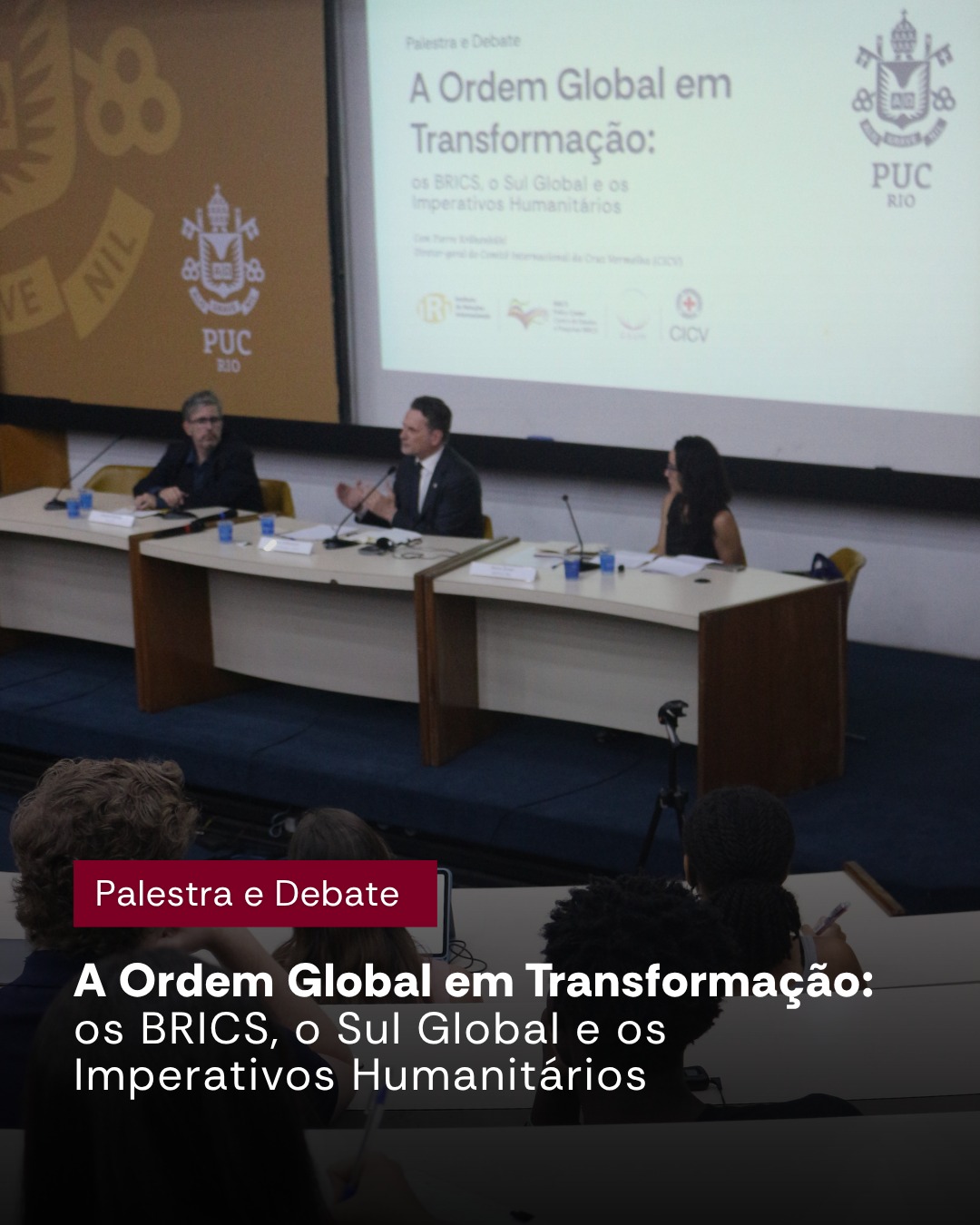
The BPC/PUC-Rio and IRI/PUC-Rio, in partnership with the International Committee of the Red Cross, held the event “The Evolving Global Order: BRICS, the Global South and Humanitarian Imperatives”.
The BPC/PUC-Rio and IRI/PUC-Rio, in partnership with the International Committee of the Red Cross, held the event “The Evolving Global Order: BRICS, the Global South and Humanitarian Imperatives”.
On April 27, 2026, we held the lecture “The Evolving Global Order: BRICS, the Global South, and Humanitarian Imperatives,” in partnership with the Institute of International Relations of PUC-Rio and the International Committee of the Red Cross (ICRC), on the PUC-Rio campus. The event featured Mr. Pierre Krähenbühl, Director-General of the ICRC, as the speaker, and included Professor Gustavo Robichez at the opening session and Professor Maíra Siman (IRI / BPC-PUC-Rio) as moderator of the debate.
In face of the increasing international conflicts, worsening geopolitical tensions, and unprecedented humanitarian crises, the future of humanitarian aid is uncertain, and International Humanitarian Law is under threat.
Considering this delicate scenario, Mr. Pierre Krähenbühl detailed the ICRC’s ongoing efforts to ensure the protection of the civilian population and defend the integrity of humanitarian norms amidst the diplomatic and operational challenges that shape the organization’s work.
Similarly, the Director-General highlighted the importance of BRICS countries and the Global South in the field of humanitarian aid, emphasizing the growing influence of these states on the international stage, enabling the construction of a more inclusive agenda adapted to local realities. Thus, these nations are consolidating themselves as indispensable political actors in defending humanitarian norms and promoting new initiatives for international cooperation amidst the transforming global order.
At the end of Pierre’s speech, the audience was invited to participate in a question and answer session, deepening the debate around current diplomatic and humanitarian dilemmas and reinforcing the importance of joint mobilization between civil society, academia, and political actors to ensure more effective humanitarian responses.
The video of the event can be found by clicking the button below.
Watch here