

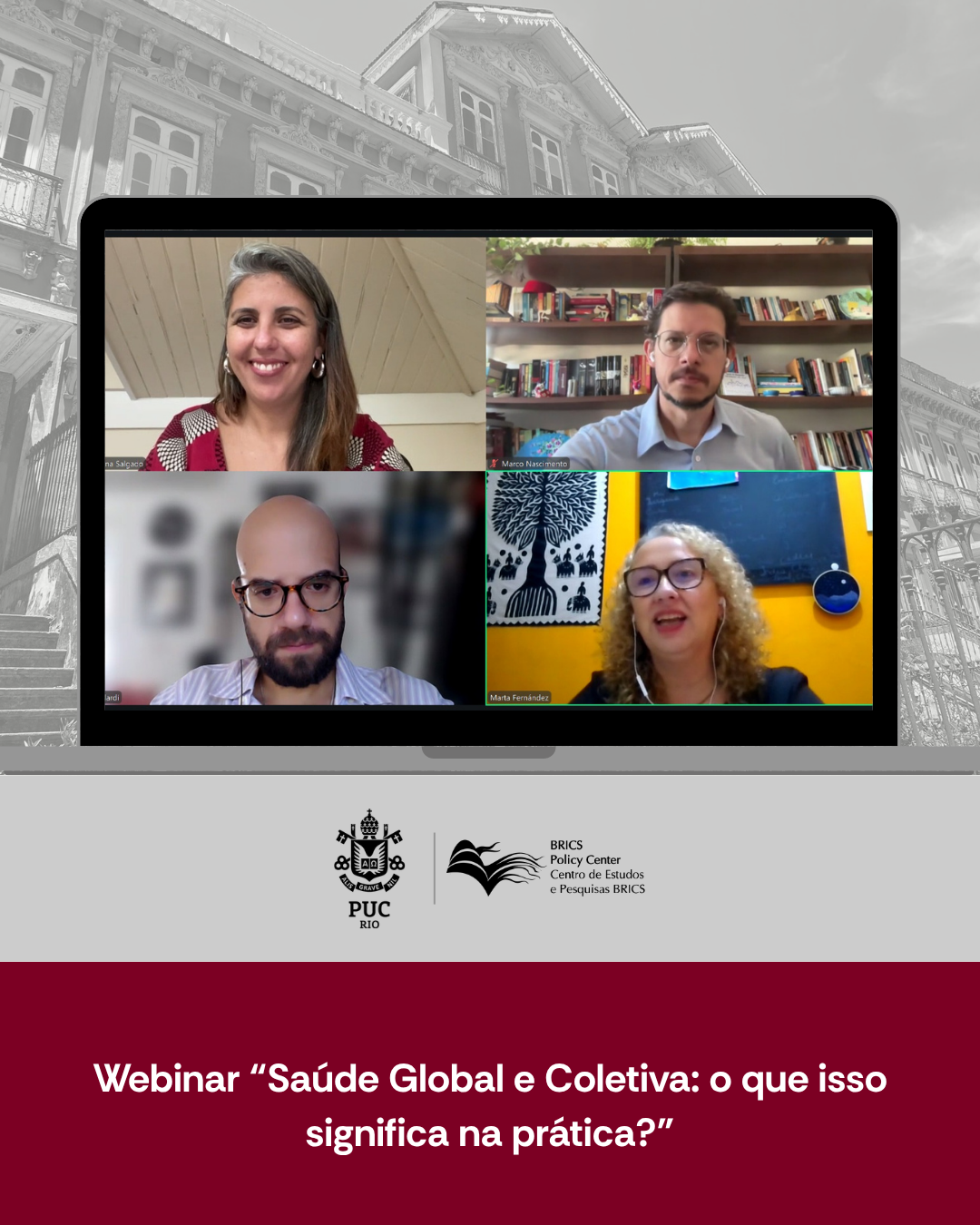
Webinar: “Global and Collective Health: What Does This Mean in Practice?”
On July 3, the BRICS Policy Center (BPC/PUC-Rio) held the webinar “Global and Collective Health: What Does This Mean in Practice?,” marking the official launch of the Global and Collective Health Research Program. The initiative launches a new research agenda dedicated to the critical analysis of global health governance, with a special focus on the contributions of the Global South, the dynamics of international cooperation, and the intersections between health, development, and social justice.
The discussion brought together Carolina Salgado, a professor at the Institute of International Relations and coordinator of the Global and Collective Health Research Program at BPC/PUC-Rio; Marco Nascimento, Deputy Vice President for Health Production and Innovation and Assistant Executive Secretary of the Global Coalition for Local and Regional Production, Innovation, and Equitable Access; and Pedro Villardi, Health Sector Coordinator for Public Services International Inter-America. Building on the question that served as the event’s title, participants discussed the practical implications of the relationship between global health and collective health.
The common starting point was the health production and innovation agenda, understood as a strategic area for addressing structural inequalities in access to technologies, medicines, vaccines, and other essential supplies. It became evident that local and regional health production represents not only an industrial strategy but also a tool for strengthening health sovereignty, the resilience of health systems, and the promotion of equity on a global scale.
The discussion highlighted the growing interdependence between health, trade, and development. In this context, participants discussed the challenges posed by the current structure of the international political economy, particularly with regard to the concentration of productive capacity, intellectual property regimes, and the disparities that limit access to health technologies.
Participants emphasized that building productive and scientific capacities in the countries of the Global South—an effort that has been gaining momentum within the BRICS framework—is a central element of health governance capable of reducing vulnerabilities, particularly in the face of health crises.
Another central theme of the debate was the role of international organizations and multilateralism in coordinating responses to global health challenges. The speakers reflected on the opportunities and limitations of multilateral institutions in a landscape marked by geopolitical disputes, shifts in patterns of international cooperation, and growing demand for more inclusive decision-making mechanisms.
In this regard, the Global Coalition for Local and Regional Production, Innovation, and Equitable Access was presented as a positive example, in contrast to the difficult negotiations surrounding the WHO’s Global Pandemic Agreement.
The discussion also highlighted the contribution of the Global South to the formulation and dissemination of new standards, practices, and agendas in global health governance. Far from merely being recipients of international standards, countries and institutions in the Global South have played an active role in developing proposals focused on local and regional production, knowledge sharing, technical cooperation, and advocating for equitable access to health technologies. These initiatives reflect an understanding of health as a global public good and a human right, strengthening alternative perspectives on international cooperation.
By fostering a dialogue among academia, public administration, and international labor representatives, the event provided an open and informed discussion on concrete initiatives currently underway in global health governance, highlighting that equitable access remains a fundamental guiding principle for the development of these innovative forms of international cooperation.
Watch the Webinar