

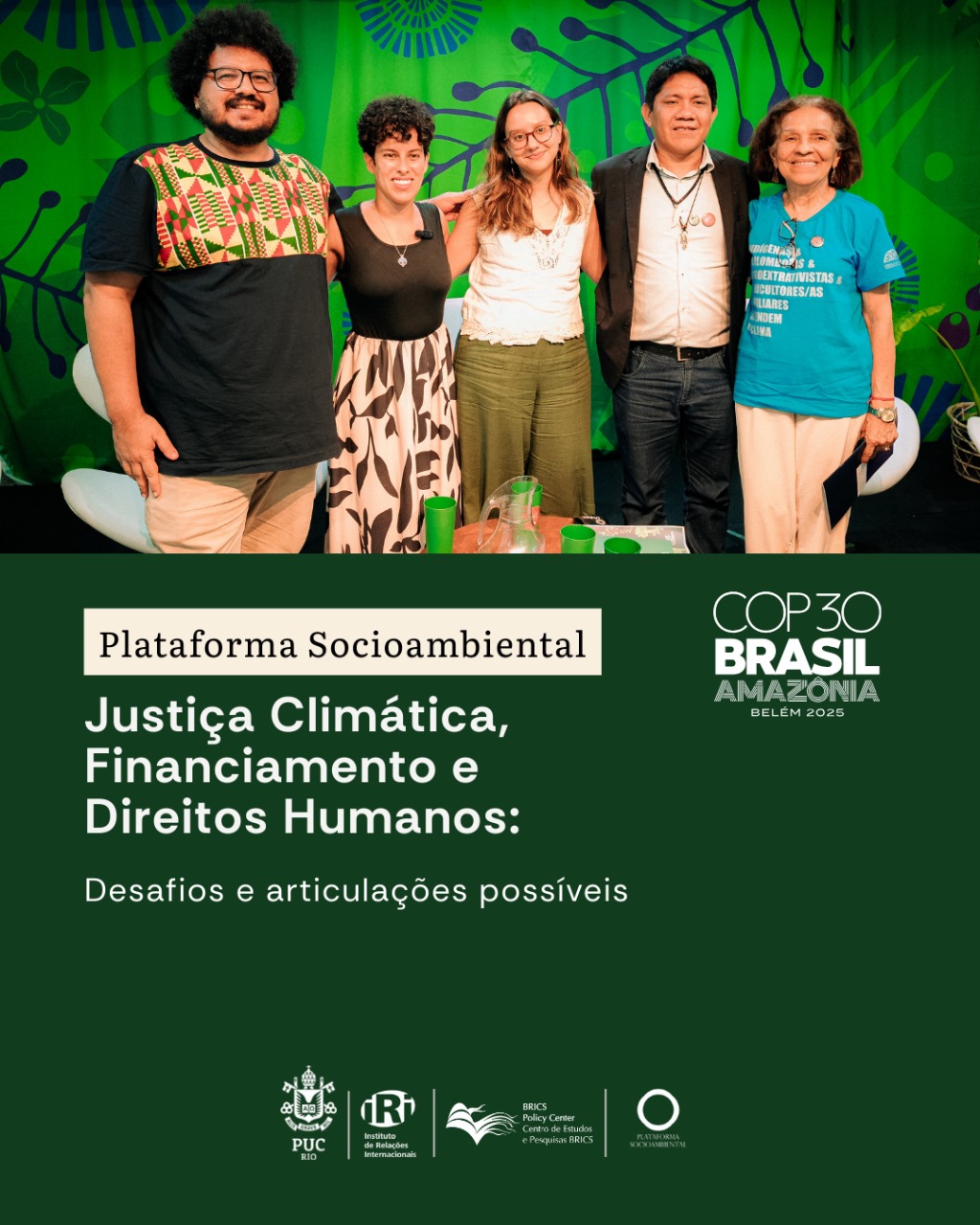
The Socioenvironmental Platform of the BRICS Policy Center at PUC-Rio co-organized the panel “Climate Justice, Financing, and Human Rights: challenges and possible alliances”
The Socioenvironmental Platform co-organized the panel “Climate Justice, Financing, and Human Rights: Challenges and Possible Alliances” at the NGO House during COP30.
The panel “Climate Justice, Financing, and Human Rights: Challenges and Possible Alliances” was held on November 18th at 6:00 PM at the COP30 NGO House, an initiative by Abong – the Brazilian Association of NGOs. The event was organized by the BRICS Policy Center’s (BPC) Socioenvironmental Platform, in partnership with the Coordination of Indigenous Organizations of the Brazilian Amazon (Coiab), FASE, the Dema Fund, and the Institute of Socioeconomic Studies (Inesc).
The meeting was facilitated by Pedro Martins, an educator from FASE Amazônia, who connected local and global perspectives by linking territorial experiences with international climate negotiations. The conversation brought together diverse voices to discuss the challenges and possible pathways for financing climate justice. Participants included:
Graça Costa, President of the Dema Fund’s Management Committee, highlighted the fund’s development process and its territorialized action. The Dema Fund is part of a network of community funds in Brazil. She emphasized the importance of recognizing these funds as political actors in climate negotiations.
Mário Nicácio, an Indigenous leader and fiscal counselor for the Podáali Fund, presented the journey of the first Amazon-wide mechanism dedicated exclusively to raising and redistributing resources for Indigenous peoples, organizations, and communities. With over a decade of development and five years of management, Podáali reaches more than 180 Indigenous peoples in the Brazilian Amazon, operating with an integrated focus on climate, people, and biodiversity.
Maria Beatriz Mello, a research assistant at the Socioenvironmental Platform/BPC, addressed the relationship between climate finance and climate justice in international negotiations, particularly at COPs. She explained how the topic was handled at COP29, with discussions on the New Collective Quantified Goal (NCQG), and how it returns to COP30, marked by the demand for increased volume of climate finance for developing countries.
Carolina Alves, a policy advisor at Inesc, contextualized the creation of the new Tropical Forests Forever Fund (TFFF), an initiative launched by Brazil at COP30. Based on an Inesc technical note, she discussed challenges in the investment model, especially the level of participation for local peoples and communities—those directly affected by the climate crisis—and what real benefits will be allocated to them. She also warned of the risk that the TFFF could reinforce the subordination of nature to market logic.