

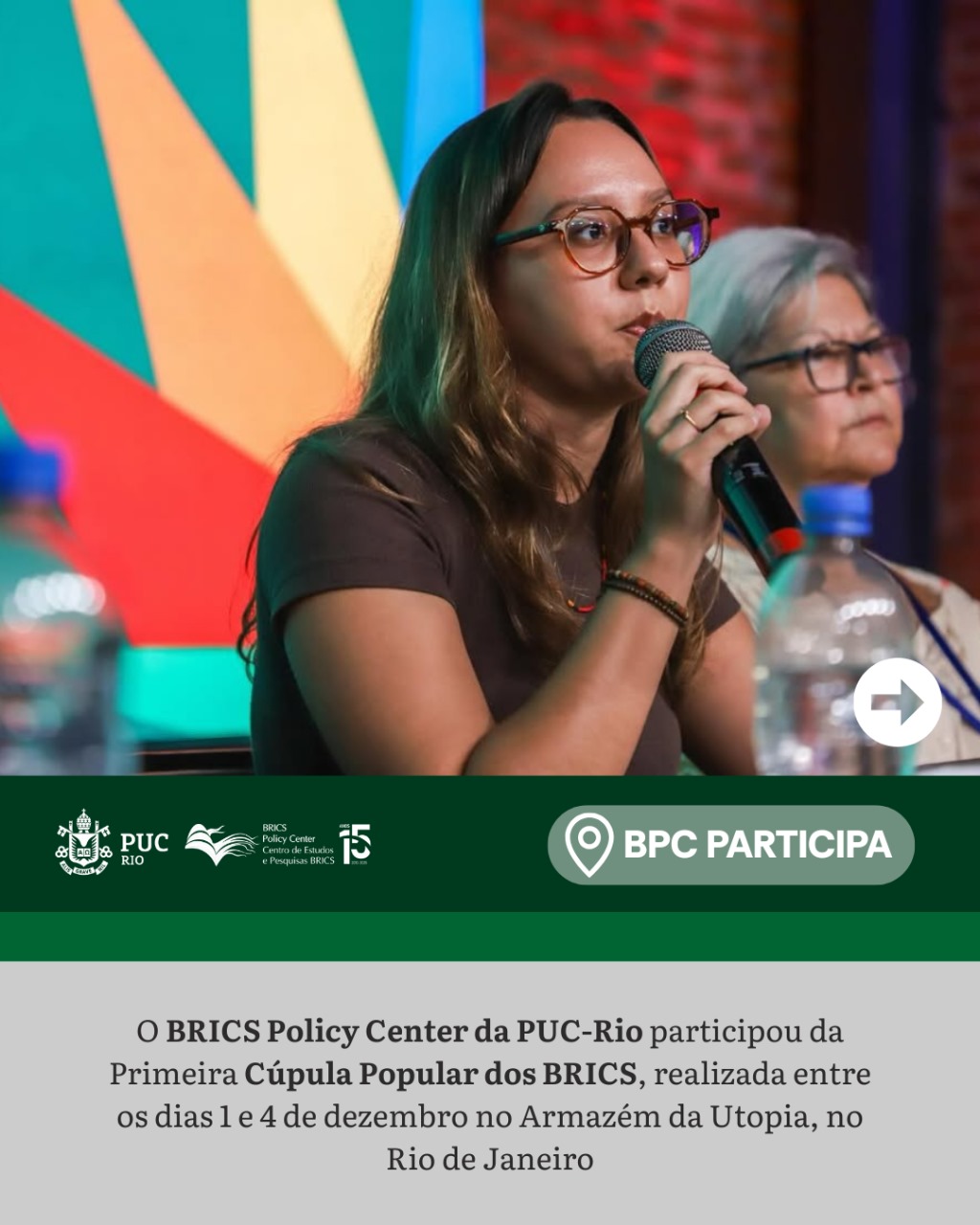
The BRICS Policy Center at PUC-Rio participated in the First BRICS People’s Summit, held between December 1st and 4th at Armazém da Utopia, in Rio de Janeiro.
Between December 1st and 4th, the First BRICS People’s Summit was held at Armazém da Utopia in Rio de Janeiro. The event brought together more than 150 representatives of civil society from BRICS countries and other nations of the Global South, with the goal of building a common agenda for the Global South over four days of activities. The BRICS Policy Center of PUC-Rio was present during several activities of the event.
The People’s Summit was the first edition of the BRICS Civil Forum (also called the People’s Council in Brazil) in an institutionalized format. The forum was officially recognized by the Kazan Declaration in Russia in 2024, with the mission of promoting permanent dialogue between governments and civil society of the countries in the bloc. With Brazil holding the BRICS presidency in 2025, this edition marked the beginning of its formal operation.
The opening session featured a video presentation by the president of the New Development Bank (NDB), Dilma Rousseff, who highlighted: “For the first time, the peoples of the BRICS countries have a permanent channel for dialogue. You are not observers, you are architects of the future we want to build.”
On the second day, the program included a panel dedicated to the agendas of the Working Groups (WGs) of the People’s Council 2025, bringing together representatives from the areas of Health, Education, Ecology, Culture, Finance, and Digital Sovereignty and Artificial Intelligence. Maria Beatriz Mello, from the Socio-environmental Platform of BPC/PUC-Rio, represented the Ecology WG. In her speech, she highlighted the alignment between national and international debates on the topic and reinforced the need to strengthen the popular forum to build, in the coming periods, a program of ecological-popular transition based on rights—to water, housing, energy, transportation, culture, health, and education.
The BRICS Policy Center’s participation was completed by director Marta Fernández and research professor Marcello Cappucci.
The Summit concluded that BRICS is currently one of the main geopolitical instruments for building multipolar governance, but criticized what they consider the bloc’s and governments’ “slowness and lack of boldness.” In this sense, participants pointed to urgent steps, such as the development of technological sovereignty with its own artificial intelligence, the strengthening of the NDB (New Development Bank), and the organization of a permanent network of social movements to monitor and pressure governments for more profound actions.